T&E 3018 - Pilot Induced Oscillations Short Course
Course Duration
One week
Course Description
The Pilot Induced Oscillations (PIO) Course is designed to provide a focused refresher for test pilots and flight test engineers with prior experience in flying qualities, handling qualities, or flight control systems in fixed wing or rotary wing aircraft. Flight testers without prior academics in Pilot Induced Oscillations are also welcome.
This course leverages the multi-decade flight test and instructional expertise of the National Test Pilot School and Flight Level Engineering faculty. Students will benefit from the use of up to three custom-built Variable Stability ground Simulators (VSS), which feature high-fidelity visual systems, a suite of programmable control system features, and a catalogue of feel system demonstrations. These include a variable stability fast jet, helicopter, and light general aviation aircraft.
Participants will reinforce and apply course concepts through a combination of lectures, hands-on laboratory exercises, and two immersive simulator sessions. Preparatory study materials will be provided to help students reengage with key foundational topics and maximize the course’s value, regardless of time away from formal academic study, and time away from pilot induced oscillations testing.
Academics
Ground instruction is carried out by experienced instructors in both the theory and practice of PIOs. The instruction in ground school includes, but is not limited to:
- Types and categories of PIO.
- Factors affecting PIO susceptibility.
- Factors in aircraft dynamics (phase loss between pilot’s input and aircraft response) and factors in flight controls system (actuator rate limiting and time delay) that can induce PIO.
- Environmental factors, flight envelope, and piloting task.
- Task/Maneuver factors.
- Process of Pilot Evaluations for Handling Qualities (HQR and PIO ratings).
- Tools for test/certification pilots (Discrete tracking, rate limiting, probe and drogue tracking, and factors like reduced stick motion and non-linear command gain).
- Demonstration maneuvers and PIO specific maneuvers (precision offset landing, aerial refueling, HUD tracking, etc.).
- PIO Flight Test Techniques (HQDT, HQST, WLB, Boundary avoidance tracking/Boundary escape tracking). This includes a hands-on laboratory on boundary avoidance HUD tracking with data analysis.
- Boundary avoidance lines (vertical variation)
- Boundary avoidance box (horizontal & vertical variation)
- PIO and pilot variability.
- Analytic Metrics (Analyzing time history for signs of PIO). This includes a hands-on laboratory on discrete tracking with data analysis.
- Discrete tracking with HAVE limits configurations 2D, 2P, and 2DU
- Displays Issues.
- Process of Pilot Evaluations
- Strength and weakness of PIO pilot ratings and PIO pilot rating scale.
- Relationship between HQRs and PIO ratings.
- Challenges in PIO ratings.
Ground Simulators:
The Ground Simulator Training is conducted on FLE’s high-fidelity ground simulators. The use of a ground simulator before flight has been shown to be the best way for our customers to link PIO theory and practice. Ground simulator instruction is a one-on-one training session with the instructors. Test pilots will receive two ground simulator sessions – Up-and-Away and Terminal demonstrations. Flight Test engineers will receive one summary ground simulator session and participate in sim sessions with test pilots. The two ground simulation sessions include but are not limited to:
Up-and-Away demonstrations (2-hour sim block) include but are not limited to:
- Discrete tracking and sum of sines for baseline aircraft.
- Discrete tracking and sum of sines for large aircraft.
- Discrete tracking and sum of sines for sluggish large aircraft.
- Discrete tracking and sum of sines for preload and friction feel characteristics.
- Discrete tracking and sum of sines for time delays in pitch and roll.
- Proverse yaw and high dihedral effect demonstrations.
- Reduced stability due to CG change demonstrations.
- Discrete tracking for pitch and roll actuator rate limiting.
- Discrete tracking for high command gain in pitch and roll.
Terminal demonstrations (2-hour sim block) include but are not limited to:
- Straight in and offset approaches for baseline aircraft.
- Offset approach with pitch lag filter.
- Offset approach with time delay in pitch and roll.
- Offset approach with sensitive pitch and roll characteristics.
- Offset approach with roll actuator rate limiting.
- Offset approach with high dihedral effect.
In this course NTPS uses up to three high-fidelity ground variable stability simulators, equipped with an electric active force feedback controls and with graphics monitors that display the same information that is available in the aircraft. For an Out-The-Window (OTW) view, three 55” high definition, curved displays are used. The OTW view is also equipped with a Heads-Up Display (HUD) to perform tracking tasks.
Flight on 6-DOF variable stability – Ryan Navion aircraft:
- Flights are optional. Please contact us for additional information.
Ryan Navion piston-powered aircraft equipped with digital Variable Stability Systems (VSS). As with other legacy VSS aircraft, the aircraft are equipped with active force-feedback control loading inceptors, custom display panels, and redundant safety features. As with other legacy VSS aircraft, these elements are fully reconfigurable in real-time, allowing for a wide range of training to occur on a single flight.
See https://www.youtube.com/@variable_stability for representative examples of some of the demos experienced in-flight using the variable stability in-flight simulator aircraft.
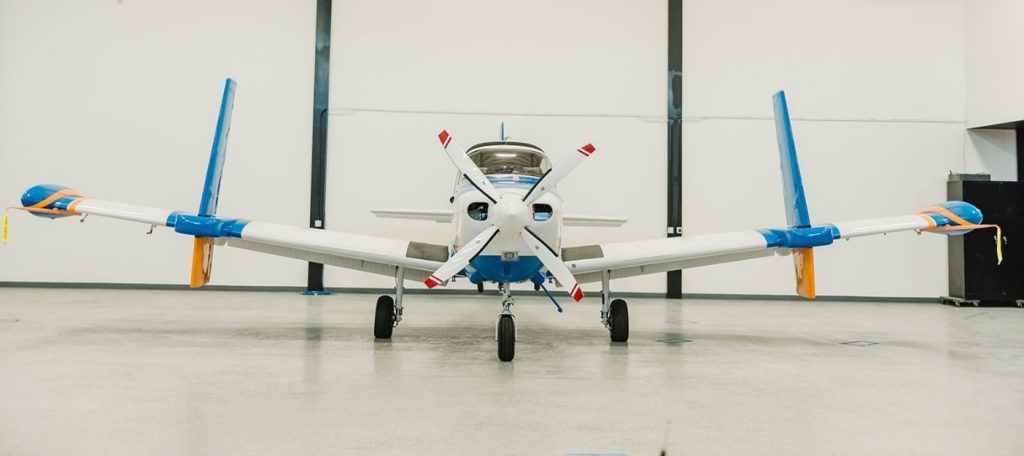
6-DOF Variable Stability – Ryan Navion Aircraft – N704VS
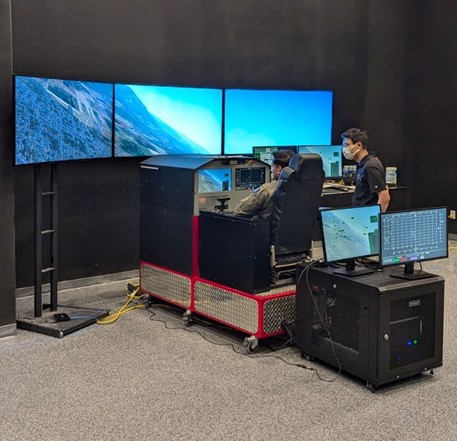
Variable Stability – Navion Ground Simulator